
HHVBP Scores are Changing Again
With the start of CY 2026, Home Health Agencies (HHAs) will again need to recalibrate how they look at their Home Health Value-Based Purchasing (HHVBP) Total Performance Scores (TPS). Understanding these changes is important since your opportunity for HHVBP bonuses will depend on how your scores compare to HHAs in your cohort. As we will discuss, whenever CMS changes the outcome measure sets, measure weights and/or baseline data, your current TPS scores are likely to change.
PY 2023/2024 to PY 2025 Changes
We saw a modest impact in TPS scores with the changes from the Performance Years (PYs) 2023/2024 when the PY 2025 measure set was introduced. Tracking TPS scores over the last three years, agencies have been improving their outcome scores. Against their agency baselines or achievement thresholds, increased outcome scores typically come with increased TPS scores.
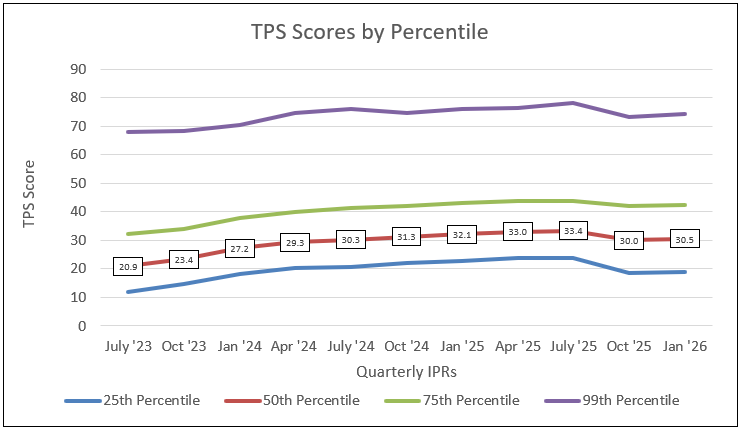
Using the CMS Interim Payment Report (IPR) data on TPS, median scores have increased every quarter except for October 2025 (larger-volume cohort TPS scores). This was the first report to reflect the new PY 2025 measure set.
Five measures were removed and three new measures were added. Your TPS score is calculated and influenced based on how well your HHA performed against the measures that were added. However, if your agency performed well on a removed measure, that strength won't carry forward, which can cause year-over-year TPS comparisons to be misleading. For the measures that didn't change, the shift in the baseline year from CY 2022 to CY 2023 also influences the TPS score. Since scores have generally improved, these measure points reset the starting point for earning Improvement and Achievement points. All other things being equal, your measure Care Points would go down.
As an example, average Dyspnea scores improved from 91.3% to 92.5% from CY 2024 to CY 2025 using data from SHP. Based on the table below, the achievement threshold increased ("was reset") 3.9% to 89.67. HHAs with a Dyspnea score of 87.0 would receive achievement points in PY 2023 & 2024 but not in PY 2025. Even if the HHA improved to 89.0 they would receive no achievement points in PY 2025. Based on SHP clients, the average Care Points decreased from 4.85 to 3.28, and the Weighted Points down from 3.22 to 2.18, even though the measure weight increased slightly from 5.83% to 6.00%.
Dyspnea Scores

We see a different story with Improvement in Oral Meds. While the SHP benchmark increased from 87.6% in CY 2024 to 88.8% in CY 2025, the achievement threshold increased by 5.2% and the Care Points went down 29.6% while the Weighted Points increased — a counterintuitive result driven by the weight change increasing significantly from 5.83% to 9.00% for the larger-volume cohort.
Oral Meds Scores

Based on all the PY 2025 measure set changes, the net impact was a decrease in TPS scores across the larger-volume cohort, as observed in the first graph. HHAs would need to evaluate how their TPS percentile rank changed to determine the financial impact as compared to their cohort peers.
PY 2025 to PY 2026 Changes
Similar to the changes from PY 2023/2024 to PY 2025 measure sets, we are seeing the same phenomenon with the change from PY 2025 to PY 2026 measure sets. Using SHP's VBP Preview 2026+ report, we can compare how TPS scores have changed compared to the VBP 2025 Preview report using the same measurement period (CY 2025).
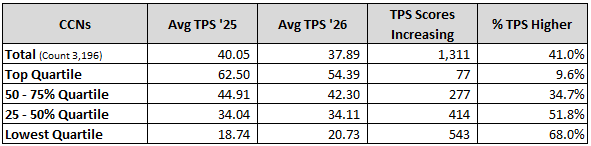
On average, SHP TPS scores decreased from 40.05 to 37.89, although 41.0% of CMS Certification Numbers (CCNs) did show an increase in TPS with the PY 2026 measure set. Interestingly, HHAs in the lowest two quartiles actually saw their TPS scores increase — 68.0% higher in the lowest quartile.
When we compare the CY 2026 measures that didn't change (where outcomes are identical in both measure sets), one can easily see the impact the changes in weights can have on the Weighted Care Points that are summed to calculate the TPS score.

For Dyspnea, the Care Points are the same as expected, but the Weighted Care Points went up from 2.63 to 2.95 — a 12.1% increase — driven entirely by the measure weight increasing from 6.0% to 7.0% for the larger-volume cohort.
Discharge Function Score (DFS) had the opposite effect. Weighted Points decreased by 3.92 points (from 14.03 to 10.11), or 27.9%. With DFS, the PY 2026 measure weight decreased from 20.0% to 15.0% for the larger-volume cohort. If your agency has been scoring well with DFS, you may see lower TPS scores under the new model.
Since TPS scores are changing for all home health agencies, the most important factor to evaluate is how your percentile rank is changing against your peers. Percentile ranking is available in the VBP Preview 2026+ report, reflecting TPS scores against all HHAs in the SHP database.
Join Us for a Deep Dive
There is a lot to unpack in looking at the PY 2026 HHVBP changes. Please join John Shewell, Kim Banker, and Chris Attaya for our CY 2026 HHVBP Insights webinar on May 6th, 2026. We plan to cover the PY 2026 HHVBP changes, Annual Payment Report (APR) PY 2023 to PY 2024 results, and how your organization should be tracking scores to improve overall HHVBP TPS performance.
Ready to understand how PY 2026 changes affect your agency? Register for our CY 2026 HHVBP Insights webinar to learn how SHP's VBP reporting tools can help you stay ahead of the curve.
About the Author

Chris Attaya
VP of Product Strategy
With more than 30 years of experience in the home health and hospice industry, Chris is responsible for product development and helping clients achieve increased operational and financial performance.