
What's Changing with HHCAHPS — And How to Improve Your Scores
Important changes are coming to HHCAHPS public reporting beginning in 2027. All of CMS's proposed changes were finalized in the Calendar Year 2026 Final Rule published December 2, 2025. HHCAHPS scores remain critical for the Home Health Value-Based Purchasing (HHVBP) Model and Care Compare, and positive patient experiences directly impact your agency's reimbursement.
2026–2027 Survey Changes: What You Need to Know
Final updates to the HHCAHPS survey instrument will roll out with the April 2026 sample month, meaning the updated survey will be disseminated in May 2026 for the first time. There are no changes to the survey administration or survey modes offered. The overall number of questions has been reduced from 34 to 25, with changes that include removing questions, consolidating existing questions, and adding a few new questions. Other minor wording changes throughout the survey increase clarity for patients.
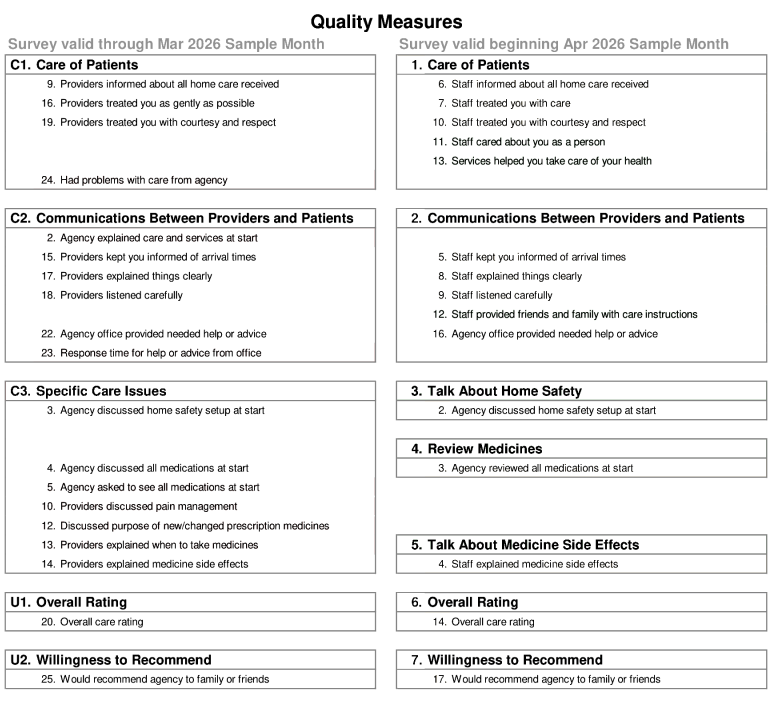
Changes to public reporting measures include modified Care of Patients and Communications Between Providers and Patients composites, along with the addition of three new standalone measures. The previous Specific Care Issues composite is being discontinued.
The Care of Patients composite has been modified and includes questions Q6, Q7, Q10, Q11, and Q13 in the updated survey. The Communications Between Providers and Patients composite has also been modified and includes questions Q5, Q8, Q9, Q12, and Q16. See table below.
The three new standalone measures are:
- Talk About Home Safety (Q2): Asks if someone from the agency talked with the patient about how to set up their home to move around safely, including discussions about fall prevention, shower bars, and removing tripping hazards.
- Review Medicines (Q3): Asks if someone from the agency talked with the patient about all prescription and over-the-counter medicines they were taking when they first started care.
- Talk About Medicine Side Effects (Q4): Asks if someone from the agency talked with the patient about any side effects of their medicines.
Overall Rating (Q14) and Willingness to Recommend (Q17) remain unchanged in the updated survey.
While the Specific Care Issues composite is being discontinued, continuing to focus on medication education, when to contact the agency, and recognizing changes in condition remains essential for overall patient satisfaction and safety.
It's also important to note that during this transition period, not all HHCAHPS measures will be updated on Care Compare equally. From October 2026 through September 2027, only Overall Rating and Willingness to Recommend will be updated quarterly on Care Compare. Of those, Overall Rating alone will drive the Patient Survey Star Rating calculation during this period.
The new standalone measures will be available to agencies confidentially through Preview Reports, but won't appear publicly on Care Compare until the October 2027 refresh. This makes your Overall Rating score more visible — and more consequential — than ever.
Updated Survey Measures at a Glance
| Measure | Status | Questions Included |
|---|---|---|
| Care of Patients | Modified | Q6, Q7, Q10, Q11, Q13 |
| Communications Between Providers and Patients | Modified | Q5, Q8, Q9, Q12, Q16 |
| Talk About Home Safety | New Standalone | Q2 |
| Review Medicines | New Standalone | Q3 |
| Talk About Medicine Side Effects | New Standalone | Q4 |
| Overall Rating | Unchanged | Q14 |
| Willingness to Recommend | Unchanged | Q17 |
| Specific Care Issues | Discontinued | — |
Strategies to Improve Your HHCAHPS Scores
Focus on the Patient Experience from Intake to Discharge
Creating positive first impressions starts with a smooth, welcoming intake process. Clearly explain services, schedules, and expectations. Inform patients the admission process takes at least an hour and to have all medications and discharge paperwork readily available. Maintain professionalism in all interactions, whether phone calls, visits, or other communications.
Consistent and reliable care means adhering to scheduled visit times and proactively communicating delays. Strive for consistency in assigned clinicians to build rapport and trust, and ensure seamless coordination among all care team members.
Effective communication is essential. Explain medical information and treatment plans clearly, avoiding jargon, and use the teach-back method. Keep patients informed about schedule or care plan changes and provide clear contact information for questions or concerns. At admission, educate patients and caregivers that they may receive a survey during or after services and emphasize the importance of their feedback.
A smooth discharge process begins with early discharge planning. Provide clear written and verbal discharge instructions. Call scheduled discharges to ask about satisfaction and address questions and concerns.
Enhance Communication Between Providers and Patients
Allocate sufficient time during visits for education and answering questions. Adapt communication styles to individual patient needs and learning preferences. Use open-ended questions to assess understanding of care plans and instructions.
Focus on Key HHCAHPS Domains
When it comes to care of patients, proactively assess and manage pain, provide emotional support and address anxieties, and thoroughly educate patients about their condition and self-management strategies.
Empower and Equip Your Staff
Provide comprehensive training on patient communication, customer service, and cultural sensitivity. Educate staff on how HHCAHPS scores affect the agency under value-based purchasing and share data regularly. Recognize staff who consistently provide excellent patient care. Conduct employee engagement surveys, as employee satisfaction directly correlates to better patient outcomes.
Proactive Feedback and Complaint Management
Solicit patient feedback throughout the episode of care. Address all complaints promptly and use them as opportunities for improvement. Analyze feedback data to identify trends and areas for improvement.
Continuous Quality Improvement
Incorporate HHCAHPS results into your QAPI program. Establish SMART goals for improving HHCAHPS scores and monitor monthly or quarterly. Implement and monitor interventions to address identified areas for improvement.
Overall Rating and Willingness to Recommend are influenced by all these factors. Consistently positive experiences across all domains will drive higher ratings and recommendations.
By implementing these strategies, your home health agency can cultivate a patient-centered culture, enhance patient experiences, and improve HHCAHPS scores — leading to better outcomes under value-based purchasing and on Care Compare.
Ready to get up to speed on the new HHCAHPS? Register for our upcoming webinar and make sure your agency is prepared for what's ahead.
Join Us for Our Upcoming Webinar
Ready to get up to speed on the new HHCAHPS? Register for our upcoming webinar and make sure your agency is prepared for what's ahead.

Join Zeb Clayton, VP of Client Services, and Doug Balser, Education Development Manager, for an in-depth session covering everything your agency needs to know about the revised HHCAHPS survey and what it means for your performance on Care Compare and within HHVBP.
The New HHCAHPS Playbook: Navigating the Revised Survey and Quality Measures
Wednesday, April 29, 2026 | 11:00 AM – 12:00 PM PDT
In this session, Zeb and Doug will walk through:
- What changed on the revised survey instrument and why it matters
- How the publicly reported quality measures crosswalk from the previous groupings to the new ones
- What agencies should expect as CMS incorporates the new survey data into public reporting
Whether you're focused on Star Ratings, HHVBP performance, or simply keeping your team informed, this session will give you the clarity you need to move forward with confidence.
About the Author

Kim Banker
Subject Matter Expert